
How Difficult is Gorilla Trekking? -Silverback Gorilla Safaris
How Difficult is Gorilla Trekking? Deep in the heart of Africa’s equatorial rainforests, a face-to-face encounter with a mountain gorilla is widely considered one of the most profound wildlife experiences on earth.
Looking into the soulful, brown eyes of a creature that shares nearly 98% of your DNA is a bucket-list privilege.
However, unlike a traditional African safari where you sit comfortably in a custom 4×4 vehicle, gorilla trekking requires you to lace up your boots and actively hunt for your prize on foot.
Many travelers book these expensive permits wondering: Can I actually handle this? Just how difficult is gorilla trekking?
The short answer is that gorilla trekking is a physically demanding activity that ranges from moderately challenging to brutally exhausting. It is more than a walk in the park.
However, with the right physical preparation, mental attitude, and gear, it is highly achievable for people of average fitness levels.
To help you prepare for this once-in-a-lifetime adventure, this comprehensive guide breaks down the physical realities, environmental factors, and logistical challenges of trekking to see the mountain gorillas of Uganda and Rwanda.
Everything to Know on How Difficult is Gorilla Trekking?
-
The Terrain: Nature’s Obstacle Course
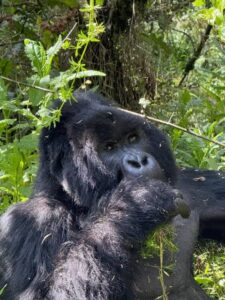 The mountain gorillas live exactly where their name suggests: in high-altitude, mountainous rainforests. In Uganda’s Bwindi Impenetrable Forest and Rwanda’s Volcanoes National Park, the word “impenetrable” and the word “volcanoes” are literal descriptions, not marketing exaggerations.
Tangled Vegetation and No Trails
After you step away from the park headquarters, your initial walk follows clear, marked trails.
However, once trackers locate the gorilla family, you will dive directly into the thick of the jungle. Park rangers use machetes to clear a path through dense undergrowth, tangled vines, and stinging nettles. You will constantly step over fallen logs, duck under low-hanging branches, and weave through thick bamboo forests.
Mud, Slopes, and Slippery Footing
Rainforests are notoriously wet, and the ground is rarely flat. You will find yourself scaling steep ridges and descending into deep valleys. The forest floor is a mix of loose volcanic soil, decomposing leaves, and thick mud.
A path that looks stable can instantly give way, making slips and falls part of the standard experience. Your core strength and balance will be tested constantly.
-
The Impact of Altitude
One of the most underestimated factors contributing to the difficulty of gorilla trekking is the elevation.
- Bwindi Impenetrable National Park (Uganda): Treks take place at altitudes ranging from 1,160 to 2,600 meters (3,800 to 8,500 feet) above sea level.
- Volcanoes National Park (Rwanda): Treks start at higher elevations, typically between 2,200 and 4,300 meters (7,200 to 14,000 feet).
At this level, the air is noticeably thinner. If you fly in from a coastal city or a low-altitude region, your lungs will feel the burn almost immediately. Even an easy walk can feel very tiring when your body works harder to send oxygen to your muscles.
Mild altitude sickness, characterized by shortness of breath and slight headaches, is a common hurdle during the initial ascent.
-
The Unpredictability of Time and Distance
When you start your day, your schedule is completely open.
Your exact walking time and distance are unpredictable.
Why is it so unpredictable?
Gorillas are wild animals in constant motion. They move through the forest looking for food, nesting in a new location every single night. Advanced trackers head into the forest at dawn to find the spot where the gorillas slept the previous night and then follow their fresh tracks.
Best-Case vs. Worst-Case Scenarios
- The Short Trek: If a gorilla family nested close to the park boundary the night before, your trek could be a relatively easy 30 to 60-minute walk through gentle hills.
- The Marathon Trek: If the family has migrated deep into the interior of the park or high up the mountain slopes, you could easily spend 4 to 7 hours hiking.
You need to be strong in both mind and body for this long journey, because once you start, you cannot turn back unless you quit completely.
-
Weather: Changing in an Instant
Gorillas live in tropical rainforests, meaning rainfall is a constant possibility, regardless of whether you visit during the “dry” or “wet” seasons.
When a downpour hits, the difficulty level spikes dramatically. Hard, dry earth changes into slippery, sticky mud.
Ravines fill with water, and visibility drops. Trekking in wet clothes adds weight to your body and saps your physical energy. Furthermore, the humidity levels under the forest canopy are exceptionally high, which means you will sweat profusely even if the air temperature feels cool.
-
Uganda vs. Rwanda: Is One Harder Than the Other?
While the core experience is similar, the physical profile of the trek differs slightly between the two primary destinations.
Rwanda (Volcanoes National Park)
- The Challenge: Higher altitude. Because this place sits at a higher starting altitude than Uganda, you can feel out of breath and get altitude sickness much quicker.
- The Relief: The terrain features more open bamboo forests, which can be easier to navigate than dense jungle undergrowth. The tracking infrastructure is exceptionally well-organized.
Uganda (Bwindi Impenetrable National Park)
- The Challenge: Steeper, more rugged terrain. Bwindi is characterized by endless ridges and valleys. You often have to hike down a steep valley and straight back up the other side just to reach the gorillas. The vegetation is much denser.
- The Relief: The lower overall altitude makes breathing slightly easier compared to the highest peaks of Rwanda.
-
How to Get Your Body Ready for the Hike?
You do not need to be an elite marathon runner to go gorilla trekking, but you do need a baseline level of cardiovascular endurance and leg strength. If your daily routine involves walking only from your house to your car, you will struggle.
Start preparing at least six to eight weeks before your trip with these targeted exercises:
- Stair Climbing: Find a stadium, a tall building, or use a stair-master machine at the gym. This replicates the continuous upward climbing required on the slopes.
- Hill Hiking: Put on your actual trekking boots, pack a backpack with a few kilograms of weight, and go hiking on local trails. This conditions your ankles and feet for uneven ground.
- Cardio Workouts: Swimming, cycling, or jogging three times a week will improve your lung capacity, helping you cope with the thin mountain air.
- Leg and Core Strength: Incorporate squats, lunges, and planks into your routine to build up the muscles needed to stabilize your body on slippery slopes.
-
The Secret Weapons: Porters and Walking Sticks
The absolute best way to mitigate the difficulty of gorilla trekking is to utilize the local support systems available at the park headquarters.
Hire a Porter
At the start of the trek, you will have the opportunity to hire a local porter for a modest fee (typically $15 to $20 USD plus tip). Hiring a porter is highly recommended for two reasons:
- Physical Relief: They will carry your heavy backpack containing your water, lunch, and camera gear, leaving you free to focus entirely on your balance and footsteps.
- Direct Assistance: Porters are incredibly sure-footed. They will literally pull you up steep muddy slopes and hold your hand to steady you on treacherous descents.
- Community Support: Hiring a porter directly funds the local community, turning former poachers into conservation champions.
Use a Walking Stick
Do not refuse the wooden walking stick offered at the park entrance. Having a third point of contact on slippery mud or loose gravel provides critical stability and saves your knees from immense strain during steep descents.
Conclusion: Is the Effort Worth It?
Gorilla trekking is undeniable proof of the old adage: the best views come after the hardest climbs.
Yes, your legs will ache. Yes, you will sweat through your clothes, scratch your arms on thorns, and likely slip into the mud at least once. But the exact moment you catch your first glimpse of a silverback gorilla sitting peacefully in the clearing, all the exhaustion evaporates.
The physical difficulty of the trek makes the reward taste sweet. By understanding the challenges of the terrain, prepping your body in advance, and accepting the help of local porters, you can transform what sounds like an intimidating ordeal into an empowering, unforgettable triumph.